Addresses
What memory compares
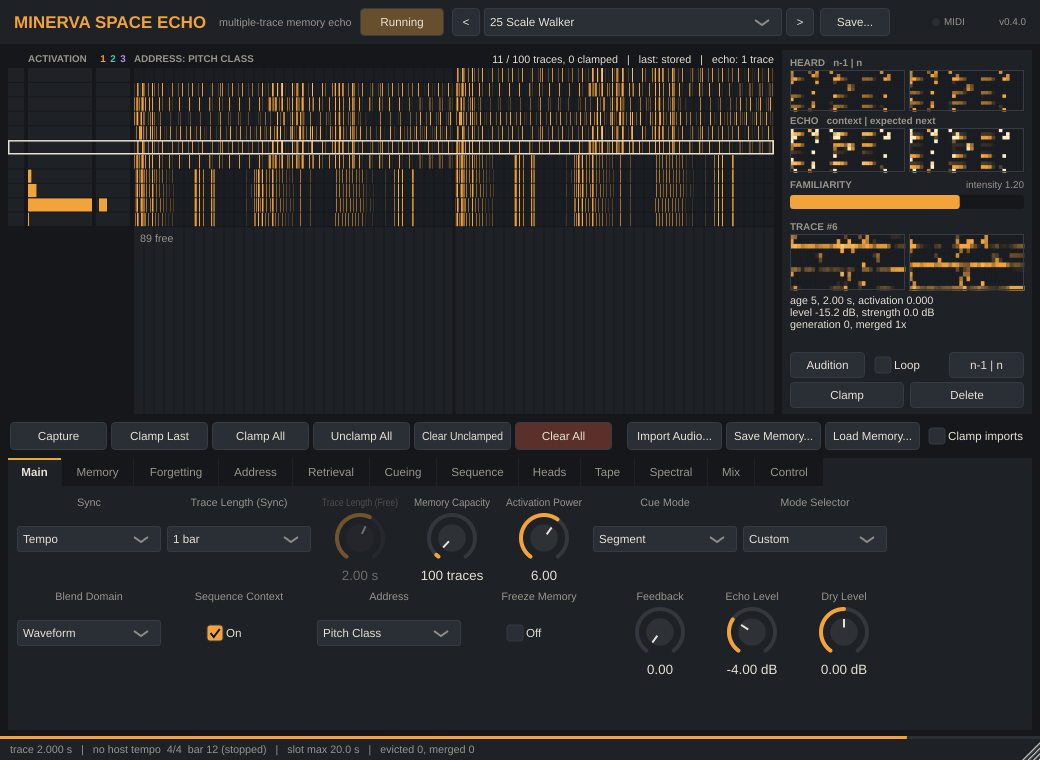
MINERVA recalls a trace when its address resembles the cue’s. What the address describes therefore decides what counts as “the same”: two bars with the same notes, the same sound or the same groove. Every trace stores five addresses, and the Address parameter (Main, Address, Retrieval and Sequence pages) chooses which one is compared.
| Address | Describes | Layout | Alike when | Different when |
|---|---|---|---|---|
| Spectrum | brightness and envelope (the original address) | 16 time slots × 24 bands, 60 Hz – 16 kHz | the overall sound and loudness contour match | the sound changes a lot; neighbouring notes look almost the same |
| Pitch Class | the notes, ignoring octave (chroma) | 32 time slots × 12 pitch classes | the same notes are played, in any octave | the notes differ |
| Pitch | the notes, with register | 8 time slots × 48 semitones, C2 – B5 | the same notes in the same octave | the notes or their octave differ |
| Timbre | the sound, not the note | 16 time slots × spectral shape and brightness | the same instrument or patch plays, whatever the note | the sound is brighter, darker or shaped differently |
| Rhythm | where the attacks fall | 96 steps × onsets in 4 frequency ranges | attacks fall in the same places (kick, snare, hats separately) | the pattern differs, whatever the notes |
All five are computed from the same audio when a trace is stored (and for imported audio), so you can switch at any time, even while playing, and memory answers differently straight away. Forgetting, encoding failure and merging apply to all of them.
Why it matters: a scale
Play a synth into memory one note per bar, C D E F G A B C′ and back to C, and let the echo chain walk memory with Predict Next. Every note has a different successor, so a memory that can tell the notes apart plays the scale back.
With the Spectrum address it doesn’t: its 24 bands are about a third of an octave wide and every note has the same envelope, so neighbouring notes are 0.98 similar (C and D) and the walk drifts. The pitch sets tell them apart:
| Similarity to C4 (a 2-bar sawtooth note) | D4 | E4 | G4 | C5 |
|---|---|---|---|---|
| Spectrum | 0.98 | 0.93 | 0.86 | 0.74 |
| Pitch Class | 0.02 | 0.06 | 0.18 | 0.95 |
| Pitch | 0.00 | 0.00 | 0.10 | 0.29 |
| Timbre | 0.87 | 1.00 | 0.95 | 0.99 |
With Pitch Class or Pitch the chain plays the scale. Pitch Class hears C′ as C, so after C′ it sometimes continues with D (what followed C); Pitch knows the octave. Hear the three walks in the listening examples (38–40).
Hearing the difference
The probe shows the table above for your own material. In the scale memory, probe the last C with n vs n−1: under Pitch, [C | D] takes all of the activation, so the probe’s echo is a D; under Spectrum it gets under a quarter, the rest going to the other notes, and the echo is a blur of the scale. Loop the echo and switch the Address to hear it change.
Mixing addresses
With Address = Custom, the similarity is the weighted mean of each set’s similarity, using the five weights on the Address page (a weight of 0 leaves a set out; all 0 means Spectrum). For example, Pitch Class 1 and Timbre 0.5 recalls the same notes, preferring the same sound. The weights can be automated to morph between them.
The memory matrix and side panel show the set being compared; with a Custom mix, the most weighted one.
How each address is made
- Spectrum: band-pass filters (24 bands, 60 Hz – 16 kHz), energy per time slot in decibels, standardised within the trace (mean 0, standard deviation 1), so level doesn’t matter.
- Pitch Class and Pitch: a short-time spectrum (~85 ms frames, 75 % overlap, restarted at each segment); its peaks are located precisely and assigned to semitones. Only semitones within 20 dB of the loudest count; the rest are 0, MINERVA’s “not encoded”, so notes that share no partials really are unlike. Pitch covers C2 – B5: lower partials fold up by octaves, higher ones are left out. Segments shorter than about 50 ms have no pitch sets.
- Timbre: the band spectrum is aligned to its first peak (a harmonic sound’s fundamental), so a transposed sound keeps its shape. Per slot: 8 cepstral coefficients (the spectrum’s shape) and the spectral centroid above the fundamental, place-coded as a bump (brightness). A bright and a dark saw on the same note are about 0.5 similar; the same saw on different notes 0.87 – 1.
- Rhythm: the rise in level (onset strength) at 96 steps across the segment, in four frequency ranges (lows, low mids, high mids, highs).
Features (Continuous or Ternary) applies to every set. Feature Focus narrows the Spectrum set only. Rolling cueing always uses the Spectrum (it searches frame by frame inside traces).
Saved memory holds every set. Memory saved by earlier versions loads with the new sets computed from its audio (the Spectrum keeps what was saved, forgetting included), and older versions can still read new files, which ignore the extra sets.
Presets
25 Scale Walker (Dreaming Sequencer with Pitch Class), 26 Melody Memory (Pitch, Predict Next), 27 Same Sound (Timbre) and 28 Groove Recall (Rhythm).