MINERVA Space Echo
A tape echo whose tape is a memory

A Roland Space Echo has one tape loop. MINERVA Space Echo stores every bar you play as a separate memory trace, and plays back an echo: a blend of all the traces, each weighted by how much it resembles what you are playing now.
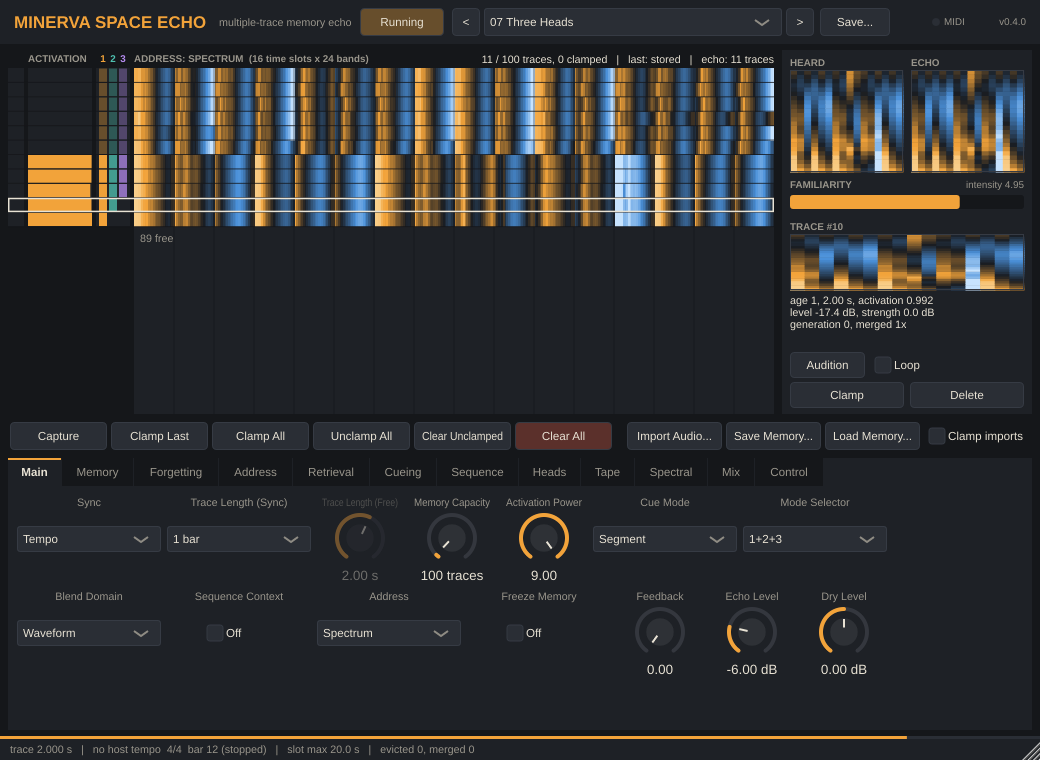
It is an audio effect (AU and VST3 for macOS, aimed at Ableton Live) built on MINERVA II, Douglas Hintzman’s multiple-trace model of human memory. With the memory set to a single trace it is exactly a 1-bar tape delay. Give it a hundred traces and it starts answering you with earlier bars that sound like this one: a delay with déjà vu.
Where to start
Install it
Download the installer, or build it yourself.
First session in Live
Ten minutes from an empty track to memory echoes.
How MINERVA works
Traces, similarity, activation and the echo, in plain terms and in equations.
Listen
Thirty-odd rendered examples, from a plain tape delay to grain clouds.
What it can do
- Remember and recall. Up to 4000 traces, from 10 ms grains to 4-bar phrases, tempo-synced or free.
- Choose what to keep. Freeze memory, gate what gets stored, clamp (lock) traces so they’re never replaced, merge similar bars into prototypes, or let memory fade and forget.
- Cue it live. Recall by the last bar, as each bar unfolds, or continuously with no bar grid.
- Be a Space Echo. Three playback heads with an RE-201-style mode selector, wow and flutter, tape drive, hiss, feedback EQ and a spring reverb.
- Blend spectrally. Mix memories as spectra so they don’t cancel, time-stretch old traces, freeze the echo into a drone.
- Show its work. A live view of the memory matrix: every trace’s address, its activation, and which heads are playing it.
- Learn sequences. Traces can hold the segment before them too, so memory anticipates what comes next, and each echo can cue the next one (after Jamieson & Mewhort’s model of sequence learning).
- Seed it. Drop audio files in to fill memory; save and reload memories as plain WAV + JSON folders.
- Play it. Presets, MIDI note control and automatable actions.
Every stage of the build plan is in place and the plug-in passes Apple’s auval and pluginval, but it has not yet been played much in Live. Expect rough edges and please report problems.
MINERVA Space Echo is open source under the AGPL-3.0. It was written by Matthew Crump with help from Claude Code; see About for how to cite it.