Sequences
Sequential context, anticipation and the echo chain
MINERVA II stores each experience on its own. Jamieson and Mewhort (2009) showed that the same model can learn sequences, as people do in the serial reaction-time task, if each trace also holds the event that came before it. The idea is close to an Elman network, which feeds its previous state back in as context for the next input. MINERVA Space Echo can work the same way.
Traces with context
Every trace stores two addresses side by side, [n−1 | n]: the segment before it and the segment itself. The audio is still just the segment itself; the context only changes which traces are recalled. In the memory matrix each row then shows both halves, with a divider between them.
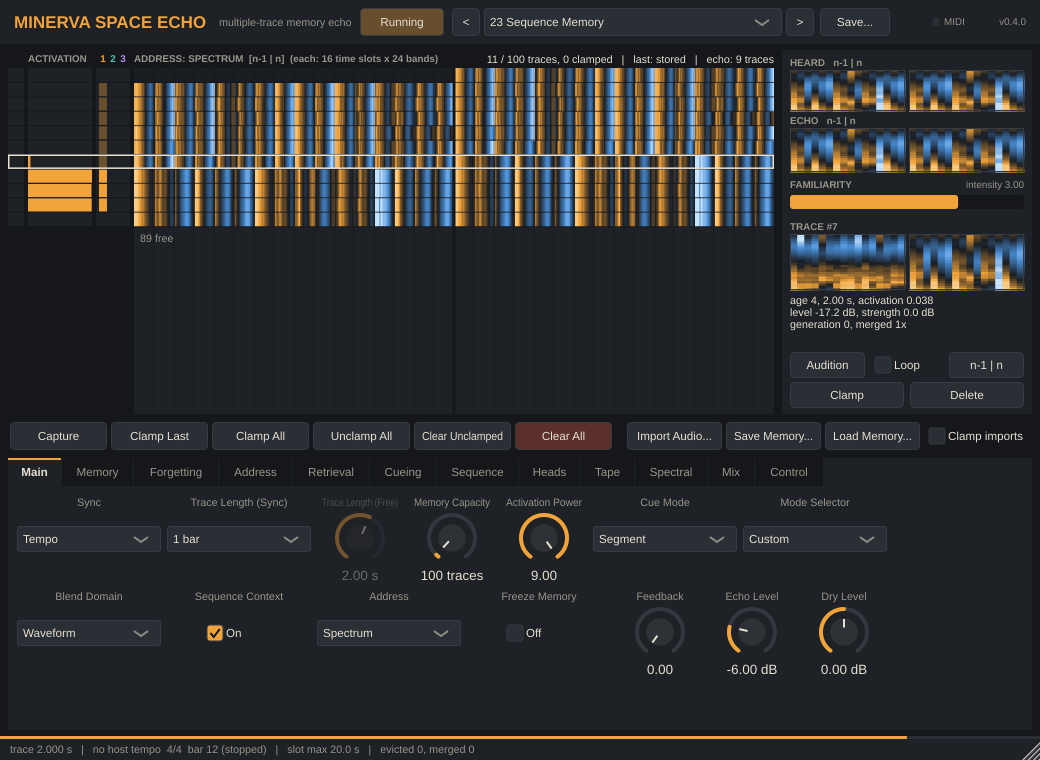
Context is always recorded, so memory that was built with Sequence Context off can use it the moment you turn it on. The first segment after starting, clearing or jumping the transport has an empty context half. Imported audio gets the previous piece of the same file as context.
Asking memory with context
Turn on Sequence Context (Main or Sequence page) and choose a Context Cue:
| Context Cue | The cue is | What you hear in the next segment |
|---|---|---|
| Predict Next | the segment just played, compared with each trace’s n−1 half | What followed similar material before: memory’s expectation of the next segment, played as it happens. This is Jamieson and Mewhort’s anticipation. |
| Match Both | the last two segments, compared with [n−1 | n] | The trace that matches both the segment just played and how you got there. The same bar is recalled differently after different bars. Context Weight sets how much the n−1 half counts. |
| Current Only | the segment just played, compared with n | Ordinary MINERVA II recall; context is ignored. |
The similarity with two halves is the weighted mean of each half’s similarity, so with Context Weight at 0 Match Both is the same as Current Only.
Traces remember only the segment before them. After a segment that has been followed by different things, Predict Next blends everything that ever followed it; Match Both uses the extra segment of history to tell the cases apart.
In Progressive cue mode the bar so far is compared with the same stretch of each trace’s context half (Predict Next) or current half (Match Both). Rolling cue mode searches the audio itself, not addresses, so it ignores context. Iterative heads use the same rule: with Predict Next, Iterative 1+2+3 plays the next three expected segments at once.
The echo chain
Each echo has content of its own: the blend of the answering traces’ addresses. With Predict Next, its n half is memory’s expectation of the next segment. Set Cue Source to Echo Chain and that expectation becomes the next cue, so each echo cues the next one and memory walks through the sequences it has learned, one segment at a time.
Chain Input decides how much the live input steers the walk:
- 0: memory plays on its own and ignores the input: a sequencer driven by its own expectations.
- In between: the input pulls the walk toward what is being played now, much as an Elman network’s context units mix the previous state with the new input.
- 1: the same as Predict Next from the input.
The chain starts from the last segment you played; switched on after you stop playing, it starts from the echo that is playing. If memory stops answering (it’s empty, or nothing is similar), it restarts from the input. Hold MIDI note base + 8 to switch to the chain while the note is down.
How each step is chosen
Chain Step decides what cues the next step:
- Sample (default): one of the traces that answered is drawn, in proportion to its activation, and its n half cues the next step. This is a random walk through memory whose transition probabilities come from the learned sequences: after a segment that was followed by B half the time and C half the time, the walk goes to B or C. With Playback = Sample the trace drawn is the trace you hear, so you hear the walk itself.
- Blend: the echo’s blended content cues the next step. It is deterministic, and because a blend drifts toward the average of what answered, it tends to settle on a prototype and repeat it, or on a short loop.
Activation Power acts like a temperature: high values make the walk follow the most expected continuation, low values let weaker continuations through.
A walk can only follow transitions memory can tell apart. With the default Spectrum address, neighbouring notes of a melody look almost alike, so the walk drifts between similar-sounding segments; with Address = Pitch Class or Pitch it follows the notes (Addresses).
Getting out of ruts
Music with repeated bars teaches memory that “the next bar is like this one”, so a walk can keep returning to the same place. Two controls help:
- Cue Noise adds random noise to every cue (the chain’s and the live input’s), so the walk sometimes lands somewhere nearby instead.
- Habituation makes traces that just answered less active for a few segments (their fatigue halves each segment), so the walk moves on, like inhibition of return.
Freeze Memory keeps the chain from recording its own output.
Try it
- 22 Anticipate (Predict Next), 23 Sequence Memory (Match Both), 24 Dreaming Sequencer (Echo Chain with sampled steps, habituation and a little cue noise) and 25 Scale Walker (the same with Address = Pitch Class) in the preset menu.
- The listening examples 34 to 40 (38 – 40: a scale walked with the Spectrum, Pitch Class and Pitch addresses).
References
- Jamieson, R. K., & Mewhort, D. J. K. (2009). Applying an exemplar model to the serial reaction-time task: Anticipating from experience. Quarterly Journal of Experimental Psychology, 62(9), 1757–1783.
- Elman, J. L. (1990). Finding structure in time. Cognitive Science, 14(2), 179–211.